Standard gauge · 1865–1946

Steam for
the Dockyard.

Thirty standard-gauge steam locomotives appear in the Dockyard register: tramway engines, saddle tanks, contractors’ locomotives and one steam railcar.

Browse the register
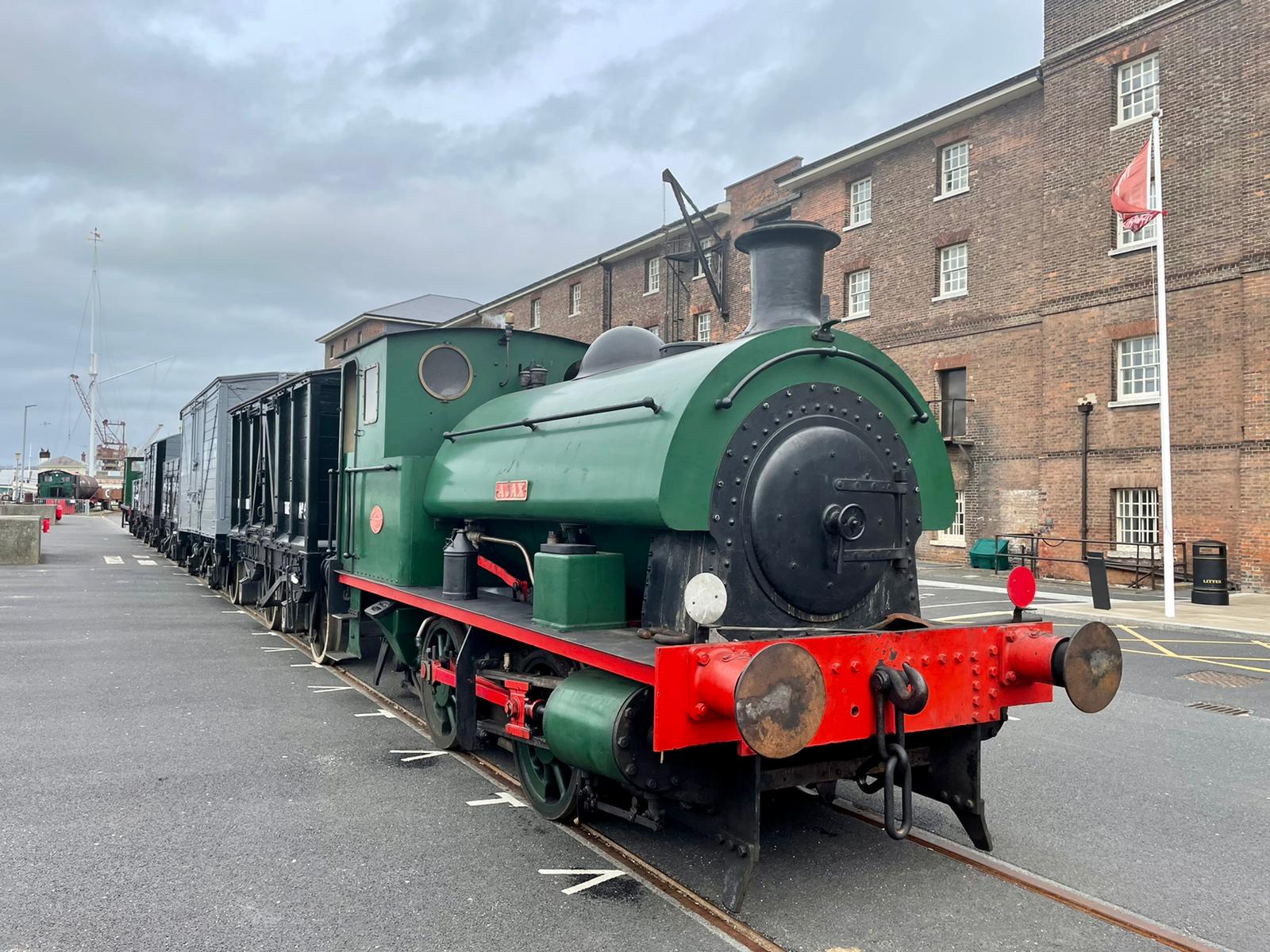
AJAX · Robert Stephenson & Hawthorns 7042/1941 Photograph from the CHDR collection
01Steam fleet overview

Thirty engines.
Many kinds of work.

Chatham’s standard-gauge steam fleet grew from the Aveling & Porter tramway locomotives of the 1860s to the industrial saddle tanks that worked through the twentieth century.

Locomotives arrived new, transferred from other military railways, or came from contractors and other railway companies. Some powered building works; others hauled stores, served as mobile power, or supplied steam to dockyard equipment.

30 recorded engines1865 earliest delivery1946 latest delivery
02Stories from the fleet

Every engine
had a journey.

From railway contractors and military lines to the Dockyard’s own workshops, these locomotives brought long working lives with them.

AJAX with a train of railway wagons at Chatham Dockyard

AJAX

Robert Stephenson & Hawthorns Works No. 7042 arrived new in 1941 as M.E.D. No. 6, later Yard No. 361. This 0-4-0 saddle tank remains at the Dockyard and is undergoing overhaul; fundraising is underway to support the work.

Follow AJAX’s story
Hawthorn Leslie Works No. 2450, Dockyard locomotive Newcastle

Newcastle

Delivered new and worked at Chatham for nearly 58 years. Sold in 1957, Newcastle passed through dealers before being preserved; it is now part of the Hollycombe Steam Collection.

Sentinel Works No. 6994 steam railcar power unit

From Brittany to DOM

Built as the power unit for Jersey Eastern Railway railcar Brittany, Sentinel Works No. 6994 reached Chatham in 1929. After sale, it was rebuilt as a geared shunter named DOM; it was scrapped in 1973.

Andrew Barclay Works No. 2199, Dockyard locomotive Victory

Victory

Victory spent its working life at Chatham until withdrawal in 1968. Rescued from a scrapyard at Swanley, it moved through the South Eastern Steam Centre and Colne Valley Railway before reaching the Epping Ongar Railway in 2012.

Andrew Barclay Works No. 2220, Dockyard locomotive Invicta

Invicta

Sold to the Invicta Locomotive Preservation Society in 1972, Invicta later moved between the Severn Valley Railway, Chasewater and Long Marston. It returned to Chatham in 2009 for restoration to working order.

Hawthorn Leslie Works No. 3865, Dockyard locomotive Singapore

Singapore

Built for Singapore Dockyard as M.E.D. No. 10, this Hawthorn Leslie locomotive returned to Britain in 1953 and worked at Chatham as Yard No. 440 until 1968. After several preservation moves, it returned to the Rutland Railway Museum in 1995 and is kept in working order.

The first six. The register lists six Aveling & Porter 2-2-0 tramway engines, Works Nos. 129, 182, 218, 718, 719 and 1023. Aveling & Porter’s records confirm 129, 182 and 218 as Chatham orders; the register notes that the remaining two may have gone directly to Portsmouth and Devonport Dockyards. All six are recorded as having worked on the Lodge Hill & Upnor Railway.

Read the Aveling & Porter story
03Steam locomotive records

Search the
steam register.

Search names, builders, works numbers, yard numbers, wheel arrangements, and recorded movements. “Not recorded” indicates that no number has been established.

Names from the Dockyard fleet. Locomotives delivered new to Chatham were named after ships built at the Dockyard.

30 records
Name / descriptionWheel arrangementBuilder & works numberDockyard number(s)AcquiredLater history / recorded fate
Aveling & Porter tramway engine (unnamed)2-2-0TGAP 129 · 1865Not recordedNewTransferred to the Chattenden & Upnor Railway
Aveling & Porter tramway engine (unnamed)2-2-0TGAP 182 · 1866Not recordedNewTransferred to the Chattenden & Upnor Railway
Aveling & Porter tramway engine (unnamed)2-2-0TGAP 218 · 1866Not recordedNewTransferred to the Chattenden & Upnor Railway
Aveling & Porter tramway engine (unnamed)2-2-0TGAP 719 · 1871Not recordedNewTransferred to the Chattenden & Upnor Railway
Aveling & Porter tramway engine (unnamed)2-2-0TGAP 718 · 1871Not recordedNewTransferred to the Chattenden & Upnor Railway
Aveling & Porter tramway engine (unnamed)2-2-0TGAP 1023 · 1874Not recordedNewTransferred to the Chattenden & Upnor Railway
Royal Engineer0-4-0STMW 602 · 1876Not recordedEx Lodge Hill & Upnor RailwaySold circa 1892 to W. Rigby, contractor, Erith
Chatham No. 4 (formerly Minories)0-6-0TLB 79 · 1880M.E.D. No. 4Ex War Department, CatterickSupplied steam to a compressor near No. 2 graving dock; sources give September 1932 and October 1933 as scrapping dates
Daisy (formerly Frank)0-4-0STHC 308 · 1887Not recordedEx Woolwich ArsenalUsed by Holloway Brothers on the new naval barracks works; recorded scrapped or sold in 1932
Vulcan0-4-0STSS 3419 · 1888Not recordedEx Woolwich ArsenalSold in 1932
Vulcan0-4-0STVF 1399 · 1893Not recordedEx Woolwich ArsenalScrapped June 1951
Shoeburyness0-6-0TVF 1436 · 1894Not recordedEx War Department, ShoeburynessRecorded as scrapped or sold
Newcastle0-4-0STHL 2450 · 1899M.E.D. No. 14NewSold in 1957; later preserved at Hollycombe
RNCF No. 4 (formerly Champion)0-6-0STMW 1620 · 1903Not recordedEx Royal Naval Cordite Factory, Holton HeathTransferred to Chatham in 1925; withdrawn and scrapped September 1932
Express0-4-0STHL 2564 · 1903Not recordedNewScrapped October 1955
Kent0-4-0STHL 2807 · 1909Not recordedNewScrapped October 1955
Hercules0-4-0CTHL 2771 · 1909Not recordedNewRecorded as scrapped or sold
Sussex0-4-0STHL 2876 · 1911Not recordedNewScrapped October 1955
Devon0-4-0STAB 1286 · 1914M.E.D. No. 27NewSold to Abelson in 1949; later hired to several industrial sites; sold for scrap in 1960
Cornwall0-4-0STAB 1386 · 1914M.E.D. No. 28NewSold to Abelson in 1949; hired to industrial sites; later fate recorded as sold or scrapped
Sentinel steam railcar power unit · Brittany / DOM4wVBTS 6994 · 1927Not recordedEx Jersey Eastern Railway · 1929Sold to George Cohen in 1932; rebuilt as a geared shunter; scrapped in 1973
Centaur0-4-0STHL 3683 · 1927Not recordedNewRecorded as scrapped or sold
Atlas0-4-0STHL 3803 · 1932Not recordedNewScrapped March 1957
Titan0-4-0STHL 3807 · 1934Not recordedNewSold in 1957
Goliath0-4-0STHL 3863 · 1935Not recordedNewScrapped in 1963
Singapore0-4-0STHL 3865 · 1936M.E.D. No. 10 (Singapore)
Yard No. 440 (Chatham)
Ex Singapore Dockyard · 1953Withdrawn 1968; preserved at the Rutland Railway Museum and kept in working order
AJAX0-4-0STRSH 7042 · 1941M.E.D. No. 6
Yard No. 361
NewAt Chatham; currently undergoing overhaul with fundraising underway
V.E. Day0-4-0STAB 2198 · 1945M.E.D. No. 7NewScrapped July 1972
Victory0-4-0STAB 2199 · 1945M.E.D. No. 8
Yard No. 398
NewWithdrawn 1968; rescued from Swanley scrapyard; moved to Epping Ongar Railway in 2012
Invicta0-4-0STAB 2220 · 1946M.E.D. No. 9
Yard No. 417
NewSold to Invicta Locomotive Preservation Society in 1972; returned to Chatham in 2009 for restoration

AP 129 · 1865

One of the first Aveling & Porter tramway engines associated with Chatham. Its 2-2-0 tramway design worked on the Lodge Hill & Upnor Railway before transferring to the Chattenden & Upnor Railway.

AP 182 · 1866

A second Aveling & Porter 2-2-0 tramway engine. Maker records identify this as one of the Chatham orders. It later worked on the Lodge Hill & Upnor Railway.

AP 218 · 1866

A third early tramway engine. Aveling & Porter records confirm the Chatham connection; it later worked on the Lodge Hill & Upnor Railway.

AP 718 · 1871

One of two Aveling & Porter engines of this number series recorded at Chatham. The Chatham engines in the group worked on the Lodge Hill & Upnor Railway.

AP 719 · 1871

Delivered in the same year as AP 718. The historic record associates the Aveling & Porter tramway engines with Lodge Hill & Upnor and later transfer to the Chattenden & Upnor Railway.

AP 1023 · 1874

The latest of the six Aveling & Porter tramway engines in the register. It was listed among the Chatham engines but worked on the Lodge Hill & Upnor Railway.

MW 602 · Royal Engineer

Royal Engineer was built by Manning, Wardle & Co. at Boyne Engine Works, Leeds, and dispatched new to the War Department’s Lodge Hill & Upnor Railway on 21 March 1876. It worked on that railway’s standard-gauge section until the line was regauged to 2 ft 6 in and the engine transferred to Chatham Dockyard.

Sold circa 1892 to contractor William Rigby of Erith, it later worked on two South Eastern Railway projects: the Bexleyheath line between Blackheath and Crayford Creek Junction (1891–1895), and new freight sidings at Hither Green for the South Eastern & Chatham Railway (1902–1911). It was advertised for sale in May 1911. Its final fate is unknown.

LB 79 · Chatham No. 4

Built at Brighton Works in 1880 as London, Brighton & South Coast Railway A1 class No. 79, Minories, this Terrier entered service in July. It worked at New Cross, Eastbourne and Newhaven, then ran Seaford services. In 1905 it became Brighton Works pilot. A new boiler, smaller 12-inch cylinders and motor-train equipment followed in 1906; it was renumbered 679 and lost its name in 1907. Rebuilt to A1X class in 1912 after 823,265 miles, it later worked from Fratton and West Croydon.

Declared surplus in January 1918, it was sold to the Admiralty for £1,200 and sent to Invergordon, then W.D. Catterick Camp in May 1919. It came to Chatham in 1920 as M.E.D. No. 4, renamed Chatham No. 4, and supplied steam to a compressor near No. 2 graving dock. It was broken up after withdrawal; the surviving sources disagree on the date, recording September 1932 and October 1933.

HC 308 · Daisy

Built by Hudswell, Clarke & Co. at Jack Lane Works, Leeds, for Pinxton Coal Company, where it was named Frank. After an overhaul at the maker’s works in late 1896, it went to Holloway Brothers in September 1897 and was renamed Daisy.

Holloway Brothers used it on the Admiralty contract to construct the New Naval Barracks at Chatham Dockyard. It was later sold to the Royal Arsenal Railway at Woolwich and subsequently transferred to the Admiralty at Chatham. Its fate is uncertain; the register records “sold/scrapped” in 1932.

SS 3419 · Vulcan

Sharp, Stewart locomotive originally supplied to the Royal Arsenal Railway at Woolwich, then transferred to Chatham. The register records a sale in 1932.

VF 1399 · Vulcan

A second locomotive named Vulcan, this one built by Vulcan Foundry and also transferred from Woolwich Arsenal. It was scrapped in June 1951.

VF 1436 · Shoeburyness

Arrived from the War Department railway at Shoeburyness. Its disposal date and final fate are not known.

HL 2450 · Newcastle

Hawthorn Leslie Works No. 2450, Dockyard locomotive Newcastle
Newcastle, Hawthorn Leslie Works No. 2450/1899.

Built by R. & W. Hawthorn Leslie at Forth Bank Works, Newcastle-upon-Tyne, and delivered new to Chatham Dockyard in 1899 as M.E.D. No. 14. It spent its working life at Chatham until sold to Thomas Ward, locomotive dealers, in October 1957.

Circa 1958 it passed to J. W. Hardwick & Sons, contractors at West Ewell, Surrey. Around 1971 it was sold to W. Lees of Farncombe for preservation. It is now part of the Hollycombe Steam Collection at Liphook.

HL 2564 · Express

One of the Hawthorn Leslie saddle tanks delivered new to Chatham. The register records scrapping in October 1955.

MW 1620 · RNCF No. 4

Built by Manning, Wardle & Co. at Boyne Engine Works, Leeds, for the Gates & Hogg contract at Conisbrough, Yorkshire, where it was named Champion. It later worked for contractors Baldry & Yerburgh at Selby, then for Walter, Scott & Middleton on the Great Western / Great Central Joint Railway construction between Ashendon Junction and Aynho (1906–1910).

Circa 1917 it was sold to the Admiralty and moved to the Royal Naval Cordite Factory at Holton Heath, Dorset, where it became RNCF No. 4. The factory made cordite and later gun propellants for the Royal Navy; after the war some of the site became an Admiralty research establishment. The locomotive transferred to Chatham in 1925, worked there until withdrawn, and was scrapped in September 1932.

It is also recorded as having worked on the Chattenden Naval Tramway, despite being allocated to Chatham Dockyard.

HL 2771 · Hercules

Originally supplied as a 0-4-0 crane tank before being rebuilt as a 0-4-0 saddle tank. Its disposal is recorded as scrapped or sold, without a firm date.

HL 2807 · Kent

Built new for Chatham and recorded scrapped in October 1955.

HL 2876 · Sussex

Built new for Chatham in 1911 and recorded scrapped in October 1955.

AB 1286 · Devon

Andrew Barclay built this locomotive at Caledonia Works, Kilmarnock, and delivered it new to Chatham Dockyard in 1914 as M.E.D. No. 27. In October 1949 it was sold to Abelson, locomotive dealers, and delivered to their Birmingham yard.

It was hired to British Cellophane at Bridgwater in 1950–51, then to Southhook Shawcross Fireclay at Boutree Hill, Ayrshire, in 1952. In 1960 it was sold for scrap to an unidentified firm in Lanarkshire.

AB 1386 · Cornwall

Built by Andrew Barclay at Caledonia Works, Kilmarnock, and delivered new to Chatham Dockyard in 1914 as M.E.D. No. 28. It was sold to Abelson, locomotive dealers, in October 1949 and delivered to their Birmingham yard.

Later hires included N.C.B. Bank Hall Colliery (1950), Shaws Glazed Brick Company at Darwen and Chesterfield Tube Company (1951), Enderby & Stoney Stanton Granite Company (1952), Albright & Wilson at Oldbury and N.C.B.O.E. Hapton Disposal Point at Burnley (1954), and Tarmac at Rose Grove. Its final fate is unknown; the register records it as sold or scrapped.

HL 3683 · Centaur

Built new for the Dockyard. The historic register lists it as scrapped or sold but does not record a date.

S 6994 · Sentinel railcar power unit

Sentinel Works No. 6994 steam railcar power unit
Sentinel 4wVBT, Works No. 6994/1927.

Sentinel built the power unit at Battlefield Works, Shrewsbury, for a steam railcar delivered to the Jersey Eastern Railway in October 1927 as Brittany. When the line closed in June 1929, the coach body and power unit were separated. The body became a garden holiday home at Greve d’Azette. A. O. Hill, shipbreakers at Admiralty Dockyard Dover, bought the railway’s plant and movable effects in November 1929. A 1931 manifest for the ship Ringwood lists a “chassis” shipped from Jersey; researchers believe it may have been No. 6994’s power unit, as no other Jersey locomotive shipment has been traced.

The Admiralty sent the unit to Chatham, where it worked until 1932. Advertised for sale in April that year, it was bought by George Cohen & Sons and recorded at their Bidder Street scrapyard by July 1933. It was hired to Canning Town Glass Works, then sold to William Jones in 1935. Rebuilt with a steel body as a 0-4-0 geared shunter, it went to J. S. Peters’ Merstham Lime Company, where it was named DOM and its gearing altered from 1:1 to 3:1.

After rail traction ended at Merstham in 1946, it moved to Standard Brick & Sand at Redhill, then the Kent & East Sussex Railway in 1962. It was sent to Aylesbury Scrap Metals in March 1973 and scrapped the following month. Its crankcase is now used in Sentinel No. 6515. A group later formed to recreate the railcar; the original Jersey body was recovered in late 2011 for a replacement coach body. The Industrial Locomotive Society helped piece together this history.

HL 3803 · Atlas

Built new for Chatham in 1932 and scrapped in March 1957.

HL 3807 · Titan

Built new for Chatham in 1934 and sold in 1957.

HL 3863 · Goliath

Built new for Chatham in 1935 and scrapped in 1963.

HL 3865 · Singapore

Hawthorn Leslie Works No. 3865, Dockyard locomotive Singapore
Singapore, Hawthorn Leslie Works No. 3865/1936; M.E.D. No. 10 at Singapore, Yard No. 440 at Chatham.

Built by R. & W. Hawthorn Leslie at Forth Banks Works, Newcastle-upon-Tyne, for the Admiralty in 1936 and sent new to Singapore Dockyard as M.E.D. No. 10. On return to Chatham in 1953, it carried Yard No. 440. It was captured during the Japanese invasion in 1942 and suffered damage; bullet holes remain visible.

It worked at Chatham until withdrawn in 1968. After preservation at the South Eastern Steam Centre, Market Overton and Rutland Railway Museum, it briefly moved to the Imperial War Museum’s Duxford site in 1992. It returned to Rutland in 1995 and is preserved in working order as a memorial to Far East prisoners of war.

RSH 7042 · AJAX

AJAX at Chatham Historic Dockyard

Robert Stephenson & Hawthorns built AJAX new for Chatham in 1941. Works No. 7042 was allocated M.E.D. No. 6 and later Yard No. 361. The locomotive remains at the Historic Dockyard and is undergoing overhaul, with fundraising underway.

AB 2199 · Victory

Andrew Barclay Works No. 2199, Dockyard locomotive Victory
Victory, Andrew Barclay Works No. 2199/1945.

Built by Andrew Barclay at Caledonia Works, Kilmarnock, and delivered new to Chatham Dockyard in 1945 as M.E.D. No. 8, later renumbered Yard No. 398. It worked at Chatham until withdrawn in 1968 and sold in August 1972, moving to a scrapyard at Swanley.

Rescued from the scrapyard, it moved to the South Eastern Steam Centre at Ashford in October 1973, to the Colne Valley Railway in April 1978, and to the Epping Ongar Railway in mid-2012.

AB 2198 · V.E. Day

Built by Andrew Barclay and delivered new to Chatham Dockyard in 1945 as M.E.D. No. 7. It was scrapped in July 1972.

AB 2220 · Invicta

Andrew Barclay Works No. 2220, Dockyard locomotive Invicta
Invicta, Andrew Barclay Works No. 2220/1946.

Built by Andrew Barclay at Caledonia Works, Kilmarnock, and delivered new to Chatham Dockyard in 1946 as M.E.D. No. 9, later renumbered Yard No. 417. It worked at Chatham until withdrawal and sale to the Invicta Locomotive Preservation Society in 1972.

It moved to the Severn Valley Railway in June 1972, then to Chasewater and Long Marston. It returned to Chatham Dockyard in late 2009 for restoration to working order.

04Beyond the Dockyard fleet

Branch engines.
Dockyard work.

Locomotives based at Gillingham also worked the Dockyard branch and assisted with movements inside the yard. They were railway-company engines, rather than part of the Dockyard fleet register.

No. 1556

Built at Ashford as No. 753, this P-class tank worked the Dockyard branch from Gillingham during the Second World War and helped with movements inside the yard.

Read the full history

No. 138

After transfer to New Brompton (Gillingham), it hauled the daily freight between Rochester sidings and Chatham Dockyard, and provided assistance within the Dockyard when needed.

Read the full history

No. 154

Briefly based at New Brompton during the First World War, this locomotive was loaned to Chatham Dockyard for several months before returning to Faversham.

Read the full history

S.E.C.R. P class · No. 1556

Built at Ashford Works in 1909 as S.E.C.R. No. 753, one of six P-class 0-6-0 tanks purchased for £1,740. It was first based at Ashford, briefly trialled on the New Romney branch, then moved to Tonbridge for Sevenoaks–Otford services. In October 1909 it took part in running trials on several routes, including Chatham Central–Strood and the Westerham branch. A 1911 general repair replaced its lever reversing gear, altered the right-hand cylinder arrangement, and made changes to the boiler fittings and blast pipe.

By July 1914 it worked the Otford–Sevenoaks and Westerham services. In April 1915 it was sent to Boulogne for the War Department’s rail network, repainted olive green with yellow numerals and renumbered ROD 5753. Repatriated in October 1916 after collision damage, it was repaired at Ashford and later worked Dartford–Gravesend. It was renumbered 556 in December 1925, A556 in November 1926, and 1556 in July 1935, when it moved to Dover. The original history also places it at Battersea for Wimbledon and Sutton line construction from 1928; its account gives the 1925 renumbering after that move, so the chronology in that passage is unclear.

It was hired to the Kent & East Sussex Railway in 1938. In January 1940 it transferred to Gillingham shed to work the Chatham Dockyard branch and assist with movements inside the Dockyard, returning to Dover by June 1945. After nationalisation it became British Railways No. 31556, moved to Brighton in 1950 and was withdrawn in June 1961. Sold to James Hodson (Millers) & Sons for work at their Robertsbridge flour mill, it was named Pride of Sussex. It moved to the Kent & East Sussex Railway in January 1971, where it was repaired, numbered 11 and repainted in the railway’s livery.

L.C. & D.R. B class · No. 138

One of six locomotives built by Dubs & Co. (Works No. 889) at Queens Park Works, Polmadie, Glasgow, and bought by the London, Chatham & Dover Railway in February 1876 for £2,675. It was allocated to Battersea and trialled between London and Dover. On formation of the South Eastern & Chatham Railway in 1899, it became No. 597.

In 1901 it transferred to New Brompton (Gillingham) to shunt the Rochester sidings, work the twice-daily freight between Rochester and Chatham Dockyard, and assist with movements inside the Dockyard. In March 1902 it received new 18-inch cylinders and a Kirtley-pattern boiler at Longhedge Works, a repair costing £538. It remained in service until withdrawn in October 1913.

L.C. & D.R. B1 class · No. 154

Built by Neilson & Co. and delivered to the London, Chatham & Dover Railway in June 1877 at a cost of £2,525. It entered service as No. 154 at Battersea, moved to Sevenoaks (Bat & Ball) in October 1891 and became S.E.C.R. No. 613 in 1899.

In October 1904 it transferred to Ashford to work the Dungeness–Dover shingle trains during harbour reclamation. After fitting of new 18-inch cylinders at Ashford Works in 1913, it moved to Faversham on 16 September. Following the outbreak of the First World War, it was briefly allocated to New Brompton (Gillingham) and loaned to Chatham Dockyard for several months, then returned to Faversham.

By early 1915 it was working for the Engineer’s Department at Richborough. In February 1917 it supplied steam to the boiler shop at Ashford Works. Between 1917 and 1918, it hauled explosives trains from Plumstead to St Johns, where a C-class locomotive took them towards Richborough; No. 613 then banked them from the rear to Knockholt summit before returning towards London.

It entered Southern Railway stock at grouping without a number change. In its final years it worked Faversham Creek services, then remained at Faversham in a stationary role after retirement in September 1924. It was towed to Ashford Works and broken up in February 1926.

05Builder key

Workshop initials,
decoded.

AB
Andrew Barclay, Sons & Co. Ltd.
AP
Aveling & Porter Ltd.
HC
Hudswell, Clark & Co. Ltd.
HL
R. & W. Hawthorn, Leslie & Co. Ltd.
LB
London, Brighton & South Coast Railway.
MED
Mechanical Engineer’s Department.
MW
Manning, Wardle & Co. Ltd.
RSH
Robert Stephenson & Hawthorns Ltd.
S
Sentinel Waggon Works Ltd.
SS
Sharp, Stewart & Co. Ltd.
VF
Vulcan Foundry Ltd.

An early record also lists M.E.D. No. 5; the locomotive has not yet been identified. Numbers recorded as Yard Nos. for locomotives sold before 1958 are shown here as M.E.D. Nos. Arrangement codes describe wheel layout; the suffixes distinguish tank types and specialist designs.